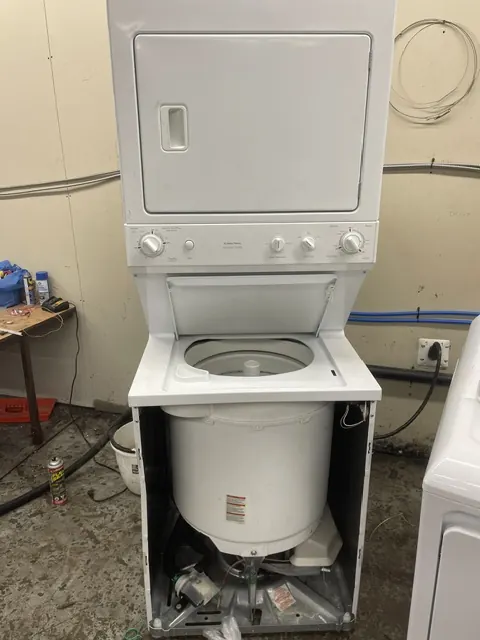
Water sitting in the tub at the end of the cycle, in a closet barely wider than the machine. Stacked laundry centres pack a washer and a dryer into one frame, and that shapes every repair.
Real RepairWell photo · A stacked laundry centre opened for diagnosis.
The short version
Why it happens, how common it is, how we fixed it
1
Why this problem happens
Small items like socks, coins and hair ties can slip past the tub and lodge in the drain pump inlet or the hose leading to it. The pump then jams or cannot move water. Kinked drain hoses and failed pumps cause the same symptom.
2
How common it is
Water left in the tub at the end of a cycle is one of the most common washer calls. A foreign object in the pump or hose is among the most frequent causes, and it is especially common on stacked units and top-loaders.
3
How we fixed it
We disconnected the unit, pulled it clear, opened the lower panel and checked the drain hose, the tub-to-pump hose and the pump. A sock had jammed the pump. We removed it, tested the pump, ran a drain-and-spin to check for leaks and reinstalled the unit without kinking the hose.
The full story
The washer finished its cycle with water still in the tub. The owner bailed it out with a jug, tried again, and got the same result.
This was a stacked laundry centre: a top-load washer and a dryer built into one frame, the kind you find in a lot of condos, townhouse closets and basement laundry nooks. They save space. They also mean the washer is only reachable from the front, under the dryer.
Getting in
With the unit unplugged, the water supply off and the hoses disconnected, we pulled it clear of the wall and removed the lower front panel. The photo shows it opened up: the outer tub in the middle, the motor and pump down at the base. On a stacked unit, how much room there is in the closet often decides how long this step takes.
What we checked
A washer that will not drain usually comes down to one of a few things:
A blockage in the drain hose, or the hose pushed too far into the standpipe.
Something small, such as a sock, coin or hair tie, lodged in the pump inlet or the hose between tub and pump.
A drain pump that has failed or is jammed.
A lid switch or control problem that stops the washer from moving on to drain.
The drain hose at the back was clear. The hose between the tub and the pump was not. A child's sock had worked its way out of the tub and into the pump inlet, and the pump impeller was jammed against it.
The same fault, a different machine
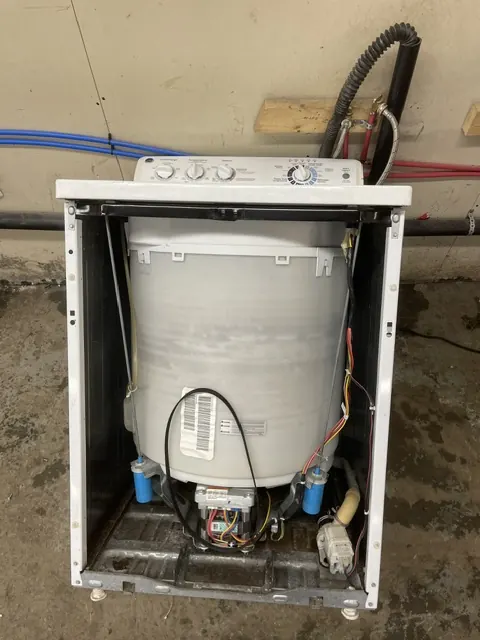
A full-size top-load washer gets the same checks, just with more room to work. This one, a different call, has the cabinet off so the pump, motor and hoses at the base can be reached.
A top-load washer with the cabinet off.
Finishing the job
With the sock out, the pump turned freely and tested normally, so it did not need replacing. We ran a drain-and-spin cycle with the panel still off to watch for leaks at the hose clamps, then refitted the panel, reconnected the hoses and pushed the unit back without kinking the drain hose.
Before you book, a few safe checks
Check the drain hose behind the washer for kinks, especially after the machine has been moved.
Make sure the drain hose goes only a short way into the standpipe and is not sealed airtight.
Check pockets before washing. Coins and small items are a common cause of drain problems.
If the washer stopped with water in the tub, turn it off and unplug it before bailing water out.
Anything involving live wiring, gas or refrigerant is technician-only.
The photos in this post are from a real RepairWell job. We use them to explain the possible causes of this problem and how it gets fixed. Every appliance is different, so your fault may have a different cause; the diagnostic visit confirms it.