Turn the knob to Normal, press start, nothing. Turn it to Heavy Duty, and sometimes it would go. A washer that picks and chooses its cycles has a fault somewhere between your hand and the control board.
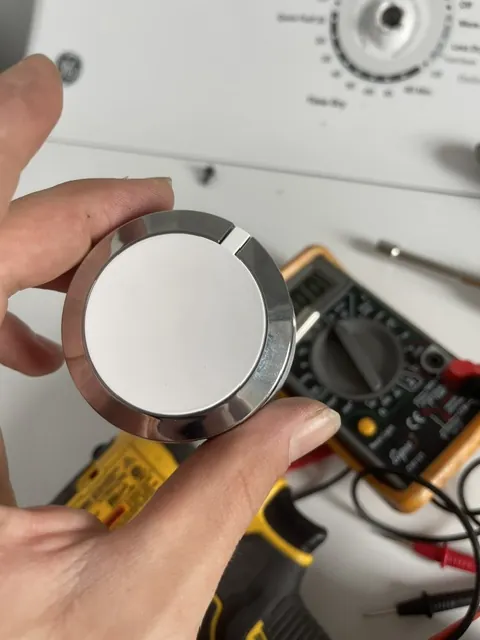
Real RepairWell photo · A console knob off for testing the switch behind it.
The short version
Why it happens, how common it is, how we fixed it
1
Why this problem happens
The cycle knob turns a rotary selector switch that tells the control board which cycle you picked. Worn switch contacts, a cracked knob insert or a corroded connector mean the board gets a garbled signal, so some cycles start and others do not.
2
How common it is
A washer that lights up but will not start is a common call. Very often it is something simple, like the lid not latching or a control lock turned on. When only some cycles work, the selector switch or its connection is a frequent cause.
3
How we fixed it
We checked the knob, then opened the console and tested the selector switch position by position and every connector on the board. Several switch positions read erratically. We replaced the user interface assembly that contains the switch and ran every cycle to confirm it responded.
The full story
Turn the knob to Normal, press Start, nothing. Turn it to Heavy Duty and sometimes it would go. The lights came on every time.
A washer that powers up but will not start, or starts only on certain cycles, has a fault somewhere in the chain between the cycle knob and the control board. The job is finding which link.
Start at the knob
The first thing we did was pull the cycle knob off. It looks simple, but the inside of the knob grips a shaft on the selector switch behind the console. If the plastic inside the knob is cracked or worn, the knob turns but the switch does not follow it all the way, and the control never sees the cycle you picked. This knob was fine.
Then the switch and the board
With the washer unplugged and the console opened, we tested the selector switch position by position. It is a rotary switch that tells the board which cycle has been chosen. Two positions read correctly. Several read erratically, which matched the pattern: some cycles worked, most did not.
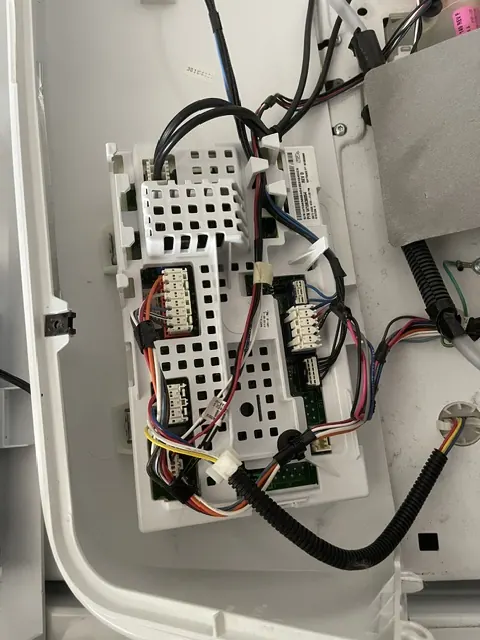
A washer's control board inside the console.
This is the control board inside the console of a similar top-load washer. The white plastic housing protects the board, and the connectors along its edges carry the signals from the selector, the lid lock, the water valves and the motor. We check every one of those connectors for corrosion or heat damage, because a poor connection can produce exactly the same symptom as a bad switch.
The fix
On this washer the selector switch is part of the user interface assembly, so that assembly was replaced. We then ran each cycle through at least its fill and agitate stages to confirm the washer responded to every position on the knob, and checked that the lid lock engaged and released normally.
Why not just replace the board
Because the board was not the fault. It would have been the more expensive part, and the washer would have kept skipping cycles. Testing first is how you avoid paying twice.
Before you book, a few safe checks
Make sure the lid or door is fully closed. Most washers will not start with the lid lock open.
Check whether a control lock or child lock is on. It is usually shown by a padlock light.
Unplug the washer for a few minutes, then plug it back in to reset the control.
Check the water taps behind the washer are fully open. Some washers will not start a cycle without water pressure.
Anything involving live wiring, gas or refrigerant is technician-only.
The photos in this post are from a real RepairWell job. We use them to explain the possible causes of this problem and how it gets fixed. Every appliance is different, so your fault may have a different cause; the diagnostic visit confirms it.