The full story
It started as a louder spin. A few weeks later there was a knock at the start of every spin, then a bang loud enough to hear from the next floor.
A front-load washer that bangs on spin has a short list of usual suspects: an unbalanced load, worn shock absorbers or dampers, loose counterweights, worn drum bearings, or a problem with the spider arm that holds the drum. Some of these are easy. Some mean taking the whole machine apart.
Ruling out the easy ones
An unbalanced load was the first thing to rule out, and the owner had already tried small, even loads. The shipping bolts had long since been removed. The dampers had some wear but not enough to explain a bang. Turning the drum by hand with the washer unplugged, there was play at the back that should not be there. That meant the drum had to come out.
What we found at the back of the drum
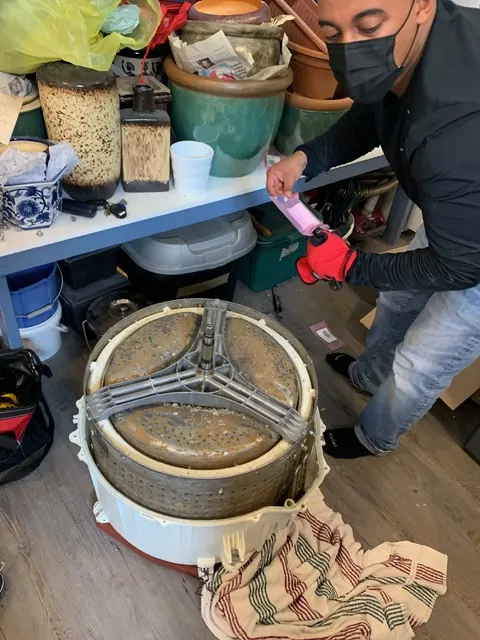
This photo is the inner drum lifted out of its outer tub, back side up. The three-armed casting is the spider. It bolts to the drum and carries the shaft that the motor turns. On many front-load washers the spider is aluminium, and over years in a warm, wet space with detergent and water-softening residue, it can corrode. Once an arm cracks or corrodes through at a mounting point, the drum no longer spins true. That is the bang.
You can also see the brown, crusted residue across the back of the drum. That builds up out of sight when a washer sees a lot of cold, short cycles, too much detergent, or detergent that is not made for high-efficiency machines. It is also a common source of the musty smell people notice in front-loaders.
Repair or replace
This is a repair where the written finding matters. Replacing a spider, and often the bearings and seal while everything is open, is a big job. Depending on the washer's age, its condition otherwise and the cost of parts, it can make more sense to replace the machine. We set out both options with the reasoning, and the owner decided.
In this case the washer was relatively young and in good condition otherwise, so it was repaired: new spider, new bearings and seal, the back of the drum cleaned, then reassembled and run through a full spin with a heavy load to confirm it ran quietly.
Before you book, a few safe checks- Redistribute the load and run a rinse and spin. A single heavy item such as a bath mat can cause banging on its own.
- If the washer is newly installed, make sure the shipping bolts at the back have been removed.
- Check that the washer is level and all four feet are firm on the floor.
- Run a hot cleaning cycle monthly and leave the door ajar between loads to let the drum dry.
Anything involving live wiring, gas or refrigerant is technician-only.
The photos in this post are from a real RepairWell job. We use them to explain the possible causes of this problem and how it gets fixed. Every appliance is different, so your fault may have a different cause; the diagnostic visit confirms it.
Related guides