Towels still damp after two cycles. The drum turned, the timer ran, and there was no heat at all. The part that failed was a two-dollar-looking disc. The reason it failed was a metre of crushed foil duct.
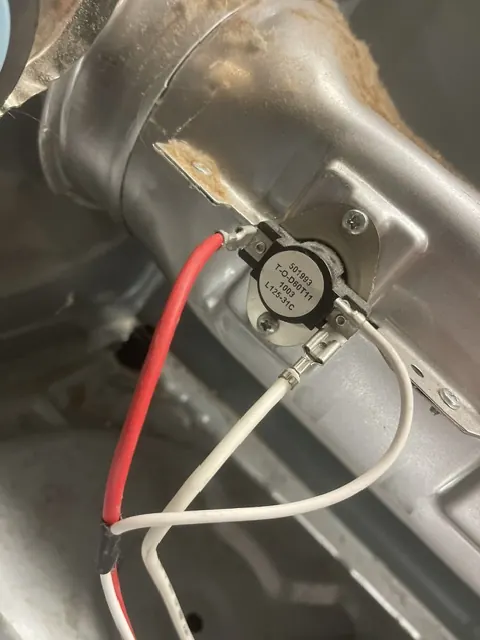
Real RepairWell photo · A dryer's heater housing and thermal cut-off, a common no-heat cause.
The short version
Why it happens, how common it is, how we fixed it
1
Why this problem happens
A thermal cut-off is a one-time safety device on the heater housing. It opens when the heater area gets too hot. That almost always means hot air cannot get out: a crushed or kinked duct, a long run of foil flex, or lint packed in the duct and the outside vent hood.
2
How common it is
No heat is one of the most frequent dryer calls we get, and a blown cut-off behind a restricted vent is among the most common causes. The telltale pattern: the drum turns, the timer runs, and there is no heat at all. Longer and longer drying times often come first.
3
How we fixed it
We confirmed full power at the outlet, then tested the cut-off, the high-limit and cycling thermostats and the timer terminals. The cut-off had opened. We replaced it together with the high-limit thermostat, cleaned the duct end to end, replaced the crushed foil with metal duct and checked airflow at the outside hood.
The full story
Towels still damp after two full cycles. The drum turned, the timer counted down, the dryer sounded normal. There was just no heat.
This is one of the calls we get most often, and it usually starts the same way. The homeowner has already cleaned the lint screen, tried a different cycle and flipped the breaker off and on. The dryer still runs cold.
First, the easy explanation
An electric dryer runs its motor on one side of the 240-volt supply and its heater across both. If one half of a double breaker has tripped, the drum can turn perfectly while the heater gets nothing. So before any panels come off, we confirm the dryer is getting full supply at the outlet. In this case it was. The fault was inside.
What we found at the heater
With the dryer unplugged and the back panel off, the heater housing told most of the story. There was lint packed along the housing and around the duct connection, far more than a lint screen should ever let through. On the housing sits the thermal cut-off, the small round safety device in the photo. It is designed to open once, permanently, if the heater area gets too hot. Ours tested open: no continuity across its terminals. That alone explains a dryer that tumbles with no heat.
But a thermal cut-off does not open for no reason. It opens because heat is building up where it should be moving out through the vent. Replacing it without finding out why is how a dryer ends up back on the same call a few weeks later.
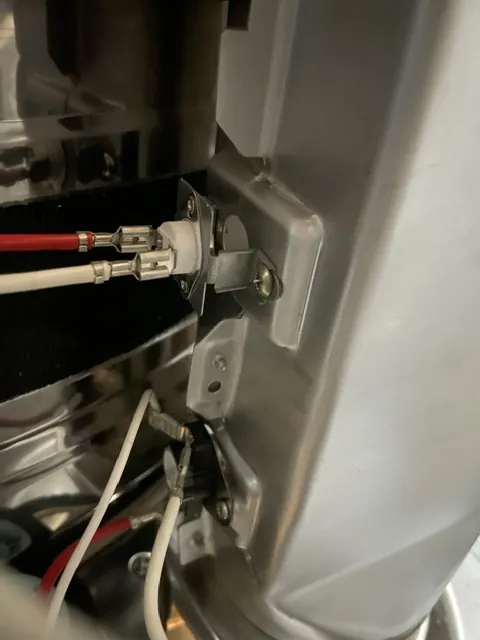
A thermostat on a dryer housing, checked during a no-heat call.
Checking everything the heat passes through
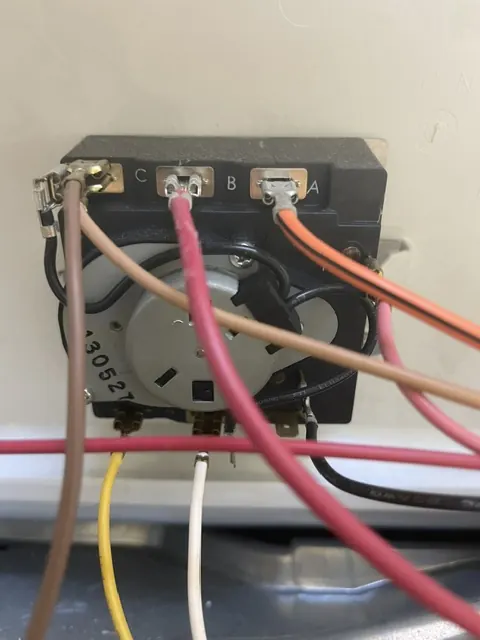
We tested the high-limit thermostat and the cycling thermostat on the housing as well, since they share the job of keeping temperature in range. Then we checked the timer terminals for the brown, heat-darkened look that points to a loose or overheated connection. They were clean.
Dryer timer terminals.
Then we pulled the dryer out from the wall. Behind it was a length of thin foil flex duct, crushed flat where the dryer had been pushed back against it. Outside, the vent hood flap barely moved when the dryer ran. Between the two, the dryer had been trying to push hot, damp air through a pinhole.
The written finding
The finding we left said three things, in plain words:
The thermal cut-off had opened and needed replacing. On many dryers it is sold as a kit with the high-limit thermostat, and we recommend replacing both together.
The cause was restricted airflow: a crushed foil duct and a lint-blocked exterior hood.
The duct should be cleaned end to end and the crushed section replaced with rigid or semi-rigid metal duct, kept as short and straight as the room allows.
After the repair and the vent work, we ran a full timed cycle and checked that the heater cycled on and off normally and that air was moving freely at the outside hood.
Why this one matters
A dryer that runs cold is an inconvenience. A dryer that keeps running hot against a blocked vent is a fire risk. The cut-off did its job. The fix was making sure it would not have to do it again.
Before you book, a few safe checks
Clean the lint screen before every load, and wash it with warm soapy water now and then if fabric softener leaves a film.
With the dryer running, go outside and check that the vent hood flap opens and you can feel strong airflow.
Check the breaker panel. A dryer that turns but won't heat can be on a half-tripped double breaker.
Leave room behind the dryer so the duct is not crushed when it is pushed back.
Anything involving live wiring, gas or refrigerant is technician-only.
The photos in this post are from a real RepairWell job. We use them to explain the possible causes of this problem and how it gets fixed. Every appliance is different, so your fault may have a different cause; the diagnostic visit confirms it.