Half a burner: tracing dead elements on a glass cooktop
By the RepairWell team ·
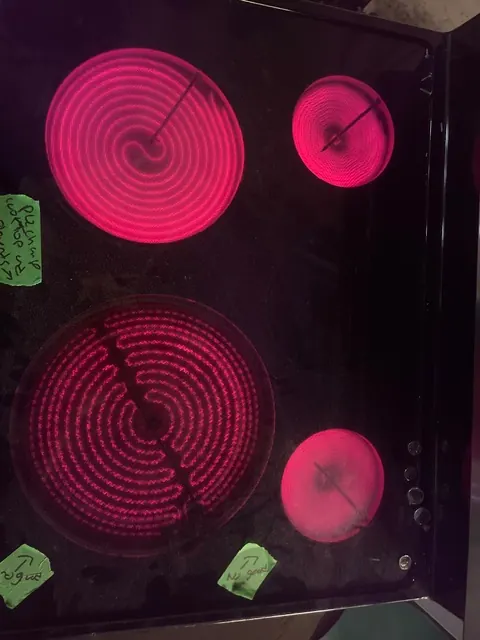
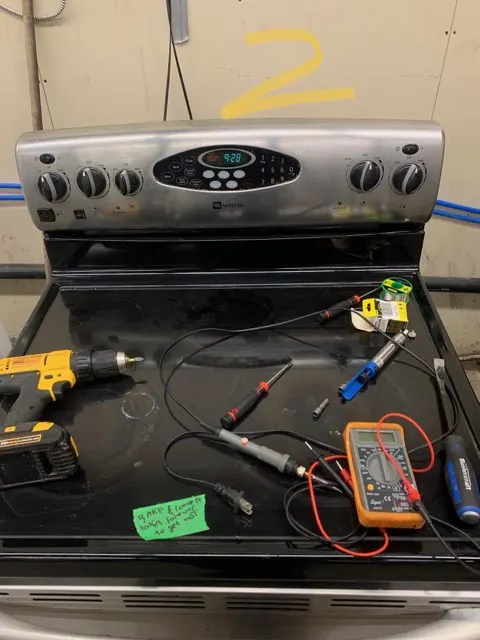
Two elements glowing properly, one with a dark stripe through it, and one that did nothing at all. The green notes on the glass are how we keep track during testing.
Real RepairWell photo · Checking every radiant element heats before the cooktop goes back in.
The short version
Why it happens, how common it is, how we fixed it
1
Why this problem happens
A radiant element is a thin ribbon coil under the glass. After thousands of heat cycles the coil can break, usually near the terminals where it flexes most. The limiter that protects the glass can also fail, as can the switch or a wiring connection that has overheated.
2
How common it is
An element that is dead, heats only partly or shows a dark band is a very common glass-cooktop fault. Large, heavily used front elements tend to go first. Dual elements often lose one ring while the other still works.
3
How we fixed it
We turned every zone on and marked what failed, then tested each element, limiter, switch and connection with the power off. Two elements had open coils. Because the glass was intact, we replaced just the two elements and tested all five zones cycling at medium settings.
The full story
The call was about one element that "only half works". By the time we had every zone on, it was two problems, not one.
Turn everything on
With a glass cooktop, the first test is simple: every element on high, lights off, and look. The photo above is that moment. The two small elements on the right glow evenly. The large rear element is fine. The large front element, marked bad, glows with a dark band across it. And the warming zone between the two small elements, marked no good, did not light at all.
The green tape notes are ours. When several zones are misbehaving, writing on the glass keeps the findings straight while the top comes apart.
What sits under the glass
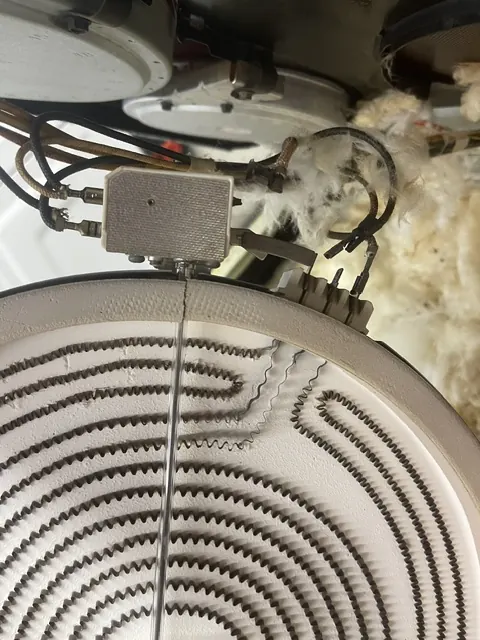
A radiant element is a thin ribbon coil set in a round insulated pan under the glass. The metal rod running across it is the limiter. Its job is to cut power to the element if the glass gets too hot, which protects the glass and whatever is sitting on it. Larger elements are often dual zones: an inner ring and an outer ring, with a switch that decides which ones run.
A radiant element under the glass, with its limiter.
That gives several possible causes for an element that is dead or heats partly: an open section of the coil, a limiter that has failed open, the switch that controls that element, or a wiring connection that has overheated. We tested each in turn with the power off.
What we found
With the glass top lifted, the front element showed a break in the coil near where it enters the terminal block, visible in the photo above. That explained the dark band. The warming zone element tested open end to end. The switches and wiring for both tested normally.
When the glass makes the decision
Elements can usually be replaced on their own. The glass is a different matter. If it is cracked or chipped, the cooktop should not be used, because spills can reach live parts underneath. In that case the choice is between a replacement glass top, often sold with elements already fitted, and a new cooktop. This glass was intact, so the repair was two elements, followed by a full test of all five zones and a check that each one cycled on and off at medium settings.
Before you book, a few safe checks
Turn on the other elements. If none heat, check the breaker before booking.
On a dual element, make sure the correct zone button or knob position is selected.
Look closely at the glass. If you see a crack or chip, stop using the cooktop and leave it off.
Use flat-bottomed pans that match the element size. Warped pans can make an element cycle more.
Anything involving live wiring, gas or refrigerant is technician-only.
The photos in this post are from a real RepairWell job. We use them to explain the possible causes of this problem and how it gets fixed. Every appliance is different, so your fault may have a different cause; the diagnostic visit confirms it.