Washer making loud noise (grinding, banging, squealing)
Many washer noises are normal, and most of the rest come from the load, the levelling or something left in a pocket; only a few point to a worn part.
Soon Most washer noise comes from the load or the levelling, but grinding that gets louder, a scrape of metal on metal or a burning smell means stopping before a small part damages the tub or drum.
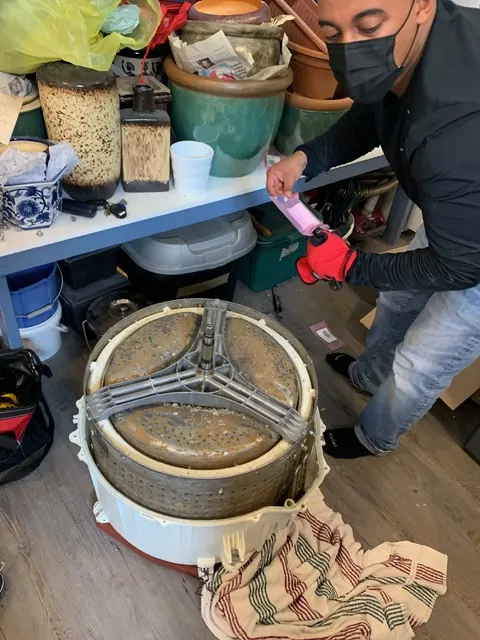
What this symptom usually means
Many washer noises are normal, and most of the rest come from the load, the levelling or something left in a pocket; only a few point to a worn part. GE lists the normal sounds of its top-loaders: a click as the lid locks, the basket spinning up and coasting down several times to sense the load, a hum and a waterfall sound during fill, an electric pulsing like a can opener as the agitator or impeller reverses, and a slurp or gurgle at the end of the drain. Whirlpool says the drive systems in its newer washers make motor and gear sounds as the motor changes direction, and that a clunk as the drive shifts from washing to spinning is expected.
Normal sound becomes a problem for four common reasons. The load is unbalanced or too big: Samsung says a loud noise with a heavy load means stopping the cycle and taking some items out, and LG says laundry stuck to one side makes noise as the tub speeds up. The washer isn't level or is touching something: Whirlpool says a drain pan can rub the bottom of the tub under a heavy load, and that hoses not tied back can bang against the cabinet. Something is loose in the drum: Whirlpool names coins and buttons, and LG names coins and wires trapped between parts. Or, on a new front-loader, the shipping bolts are still in. When none of those fits, and especially when a grind or roar during spin has been getting louder over weeks, the possibilities move to worn tub bearings, the drain pump, a belt or pulley on belt-drive machines, or the suspension. Those need a technician to confirm.
Checks you can do yourself
- Note when the noise happensListen for whether it comes during fill, wash, drain or spin, and whether it happens with every load or only big ones. GE's list of normal sounds is tied to the stage of the cycle, so a sound at an unexpected stage is the useful clue. A short phone video helps the technician too.
- Stop and lighten the loadIf the noise started with a heavy or bulky load, pause the cycle and take a few items out. Samsung says this type of noise is, in most cases, due to overloading. LG suggests filling the drum to about two-thirds and spreading heavy items so they don't clump on one side.
- Check pockets and the drumWith the washer off and empty, run your hand around the drum and through the folds of a front-loader's door seal for coins, hair pins, buttons and bra underwire. Whirlpool and LG both name loose objects as a cause of rattling or squeaking in spin. Check pockets before the next load.
- Level itPush down on opposite top corners. If it rocks, adjust the feet until all four sit firmly on the floor; Whirlpool suggests checking with a level side to side and front to back. Tighten the lock nuts on the feet if your model has them, so they don't creep back.
- Hoses, cords and neighboursTie back the drain and fill hoses so they can't strike the cabinet; Whirlpool mentions the beaded strap supplied with some models, or a wire tie. Samsung names cords and hoses rattling against the washer as a cause. Move anything leaning on the machine, and leave a small gap to walls and dryers.
- Drain pan or platformIf the washer sits in a drain pan, check that the tub isn't rubbing it. Whirlpool says extending the levelling legs may give enough clearance. Check a pedestal or platform for loose fasteners too.
- Front-loaders: pump filter and shipping boltsIf your front-loader has a small access panel at the bottom front, clean the pump filter as the manual shows, with towels and a shallow pan ready for the water. On a newly installed front-loader, look at the back for the shipping bolts or their plastic spacers; if they are still there, don't run it until they are removed as the installation guide describes.
Nothing above involves gas, wiring, refrigerant or removing panels.
What you notice, and what it can point to
Listed in no particular order. They help you describe the problem; only an inspection confirms the fault.
Rhythmic thump or bang in spin, worse with bedding or towels
Could point to: Unbalanced or oversized load (Samsung, LG)
Next step: Stop, spread or remove items, restart the spin
A single clunk when the washer switches from washing to spinning
Could point to: The drive shifting modes; normal on many models (Whirlpool)
Next step: No action if it's brief and happens once per shift
Rattle or metallic ticking in spin
Could point to: Coin, button or underwire loose in the drum (Whirlpool, LG)
Next step: Check the drum and door seal; book if it continues
Banging against the side of the cabinet
Could point to: Loose hose, washer not level, or tub rubbing a drain pan (Whirlpool)
Next step: Tie back hoses, level the washer, raise the legs above the pan
Grinding or buzzing only while water drains
Could point to: Something in the drain pump, or a dirty pump filter on front-loaders (Samsung)
Next step: Clean the pump filter if your model has one; book if unchanged
Roar or rumble in spin that has grown over weeks
Could point to: Possible worn tub bearings
Next step: Avoid high-speed spins and book a diagnosis
How it differs by design
- Top-loader with an agitator: the post in the centre reverses constantly. GE describes the electric pulsing this makes as normal, and Whirlpool describes a clunk when the drive shifts between washing and spinning.
- Top-loader with an impeller: a low disc in the tub floor rolls the clothes through less water. GE lists humming or grinding from the impeller turning in alternating directions among the normal sounds, so a steady hum during the wash is expected.
- Front-loader: the drum sits on a bearing at the back of the tub and hangs on springs and dampers. Shipping bolts must come out before first use; Samsung says a freed drum moves freely and bounces slightly when pressed. Most front-loaders also have a pump filter at the bottom front, and Samsung links a grating or grinding sound every cycle to a dirty one.
- Belt drive or direct drive: a belt-drive machine can squeal or slap from the belt or a pulley. Direct-drive machines have no belt, so a new squeal on those points elsewhere, often to something caught between the drum and tub.
- Where the washer sits: a washer on an upper wooden floor or in a closet with close walls tends to transmit more sound and vibration than one on a concrete basement slab. LG suggests leaving clearance from nearby furniture that can vibrate against the machine.
What our technician checks
These need panels off, live electrical tests or a licensed trade, so they are left to the technician:
- Removing the front, top or rear panels to reach the tub, pump, belt or motor
- Checking bearing play, suspension parts or the drive coupling with the washer opened up
- Retrieving objects lodged between the drum and tub or inside the pump housing
- Any test on motor or control wiring
Waived when you go ahead with the repair. You get the cause, the price and our repair-or-replace verdict in writing before any work.
Repairs a technician may recommend
After inspection, not from the symptom alone.
Tub bearing and seal assessment
When a roar or rumble in spin has grown over weeks, often with play in the drum when you lift it by hand. On many front-loaders the bearings are pressed into the tub, so the technician weighs the repair against the washer's age before quoting. Our repair-or-replace method explains how.
Drain pump or pump filter service
When a grind or buzz happens only while water is draining. An object lodged in the pump housing can sometimes be removed; a worn pump is replaced.
Drive belt, pulley or motor coupling
On belt-drive machines, when there is a squeal or slap in spin or agitation. The technician checks the belt's wear and tension and the pulleys for damage.
Suspension springs, dampers or rods
When the tub bangs the cabinet even with a balanced load on a level floor. See washer shaking or walking for that symptom.
Agitator parts or impeller
When a top-loader clicks or grinds in the wash and the agitator slips on its shaft. Worn cogs or a stripped coupling can often be replaced without touching the drive.
Removing a trapped object
When an underwire, coin or clip has worked its way between the drum and the tub. Reaching it may mean removing the pump, the heater or a panel.
Brands we see with this problem
Codes, parts and access differ by brand; the brand pages cover where the model label is and what to expect.







Brand-specific repair and error-code guides
Cost, and whether to fix it
What the repair costs depends on the part, the labour and whether a second visit is needed for an ordered part; the written finding gives the total before any work. Our guides on what drives repair costs, washing machine repair costs and repair versus replacement explain how to weigh it.
When to book
Book when the noise continues with a balanced, normal-sized load, a level machine and an empty drum, or straight away if you hear grinding or scraping in spin. Tell us the brand, whether it's a top-loader with an agitator, one with an impeller, or a front-loader, and at which stage the noise happens. A phone video with sound is useful. The visit is $89, waived if you go ahead with the repair, and you get the cause, the price and our repair-or-replace verdict in writing before any work. We cover Ottawa and Gatineau, from Kanata and Orléans to Aylmer. Washer repair explains what the diagnosis covers, or you can request a visit.
We handle this across Ottawa and Gatineau
Related problems
Washer making loud noise (grinding, banging, squealing): questions
Why is my washer so loud when it spins?
Most often the load is off-balance, the washer isn't level, or something is loose in the drum. LG says laundry stuck to one side makes noise as the tub speeds up, and Samsung says loud spin noise is in most cases due to overloading. If it's loud with a small, even load on a level machine, the bearings or suspension may be worn.
Is it normal for a washer to make a grinding or humming sound?
Some of it is. Whirlpool says the drive systems in its newer washers make motor and gear sounds as they change direction, and GE describes an electric pulsing, like a can opener, during the wash. LG says a motor hum at top spin speed is not a defect. Scraping or metal-on-metal sounds are not normal.
What does a squealing washer mean?
On belt-drive machines, a squeal often comes from the belt or a pulley. LG says coins or wires caught between parts can squeak as the tub turns. Check the drum for loose objects first; a squeal that continues with an empty drum is a job for a technician.
My new front-load washer is banging. What should I check?
The shipping bolts. They lock the drum for transport and must be removed at installation. Samsung says a freed drum moves freely and bounces slightly when you press it. If the bolts are still in, don't run the washer until they're out.
Can I keep using a noisy washer?
If the noise was a load or levelling problem, fixing that is enough. If it's grinding, scraping or a roar in spin, stop using it: a worn bearing or a loose part can damage the tub or drum, which can turn a repair into a replacement.
Sources
- Whirlpool Product Help: Grinding or rubbing noise (top load washer)
- Whirlpool Product Help: Bang or banging noise (top load washer)
- Whirlpool Product Help: Clunk or clunking noise during spin
- GE Appliances: Top load washer, normal sounds
- Samsung US: Samsung washing machine is too noisy
- LG USA: Top load washing machine noise when spinning
Sources checked 2026-09-24.
Book the diagnostic
Tell us this symptom and your postal code; it helps us bring the right parts.
Online booking is a request. We confirm the appointment by text or phone within 1 business hour.
- $89 diagnosticWaived when you go ahead with the repair
- Written finding on every visitCause, price and our repair-or-replace verdict
- 90-day warrantyOn labour and the parts we install