Top-load washer not agitating
A top-load washer that fills but doesn't agitate is often waiting on something rather than broken: a lid it can't sense, a pause, a presoak, or a load-sensing step.
Not urgent A washer that won't agitate is an inconvenience rather than a hazard, but a hot-motor smell or a hum with nothing moving means switching it off rather than letting it keep trying.
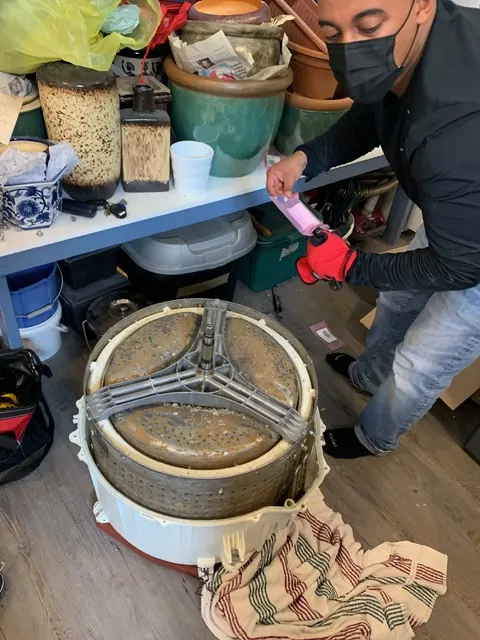
What this symptom usually means
A top-load washer that fills but doesn't agitate is often waiting on something rather than broken: a lid it can't sense, a pause, a presoak, or a load-sensing step. GE says its top-loaders take about 20 to 30 seconds to sense the load and engage the drive, that they won't agitate with the lid up, that some cycles soak for 15 or 30 minutes before the main wash, and that an accidental press of Pause or Start/Stop, or a speed selector left between positions, will stop the machine. A power spike can also leave the motor needing a reset. Whirlpool adds two causes of clothes that barely move: a low-water cycle chosen for a load that needs a deep fill, and an unbalanced load, which makes the washer stop to refill and rock back and forth to redistribute.
Newer machines can also look as if they're not agitating when they are. Many top-loaders now use a low impeller instead of a tall agitator, and move clothes by rolling them through less water; GE describes the impeller turning in alternating directions. If the lid is closed, the cycle is right and a reset doesn't help, the possibilities are mechanical or electrical. GE says a missing or damaged lid probe or magnet stops both agitation and spin. On agitator machines, worn cogs or a stripped coupling can let the motor turn while the agitator stays still. The drive motor, its control, a belt on belt-drive models, or the shifter that changes the drive between agitate and spin can also fail. Those need testing by a technician.
Checks you can do yourself
- Give it a minuteGE says its top-loaders take about 20 to 30 seconds to sense the load and engage the drive, and many models spin the basket slowly or pause during fill. Wait a full minute after the water stops before deciding it isn't agitating.
- Lid fully closedClose the lid firmly. GE says the washer won't agitate with the lid up. Look for the small plastic probe on the lid and the matching slot or magnet on the cabinet; GE says if either is missing or broken, the washer won't agitate or spin. Don't tape, wedge or bypass it.
- Pause, presoak and settingsMake sure Pause or Start/Stop hasn't been pressed, and that the cycle or an option doesn't include a presoak. GE says some cycles soak for 15 or 30 minutes before the main wash. On models with a speed selector, GE says a switch left between positions can stop the washer.
- Cycle and water levelWhirlpool says a low-water wash chosen for a bulky or heavily soiled load can leave clothes struggling to move; use a deep-fill or Bulky cycle as your manual describes. Don't pack the tub: clothes need room to move freely.
- Balance the loadWhirlpool says an unbalanced load can stop agitation while the washer refills and rocks to redistribute the clothes. Spread items loosely and evenly around the agitator or impeller, and wash large single items with a few smaller ones.
- Power resetUnplug the washer for one minute, or switch off its breaker. GE's motor reset for its top-loaders is then to plug it back in and, within 30 seconds, lift and lower the lid six times within 12 seconds, raising it at least 5 cm (2 in) each time. Other brands use different resets, so check the manual.
- Cold storageIf the washer sat in an unheated garage, cottage or porch through a cold spell, GE says water can freeze in the pump. Let the machine warm up to room temperature before running it.
Nothing above involves gas, wiring, refrigerant or removing panels.
What you notice, and what it can point to
Listed in no particular order. They help you describe the problem; only an inspection confirms the fault.
Water fills, then nothing moves for 20 to 30 seconds
Could point to: Load sensing and the drive engaging (GE)
Next step: Wait a minute before deciding it's a fault
Washer sits full of water for 15 or 30 minutes
Could point to: A presoak built into the cycle (GE)
Next step: Check the cycle and options selected
Clothes barely move in a low-water cycle
Could point to: Cycle choice or an overloaded tub (Whirlpool)
Next step: Use a deep-fill or Bulky cycle and a smaller load
Motor sound and a turning shaft, but the agitator stays still
Could point to: Worn agitator cogs or coupling
Next step: Book; it's often a modest part
No agitation and no spin, lid closed
Could point to: Lid probe, magnet or lid switch not registering (GE)
Next step: Check the probe and magnet; try the reset; book if unchanged
Hum or click with nothing moving
Could point to: Motor, drive or control fault possible
Next step: Switch it off and book
How it differs by design
- Tall agitator: the post in the centre twists back and forth. On many two-piece agitators the upper section is designed to turn freely in one direction, so a top section that spins by hand is not a fault on its own. The lower section should not slip.
- Impeller (low-profile) washers: there's no post, and the clothes move more slowly and in less water. Whirlpool says a low-water cycle can leave a bulky load barely moving, so the cycle choice matters more on these machines.
- Mode shifter or transmission: some machines change between agitate and spin with a shifter; GE says a metal clank as it engages is normal on its models without a transmission. Older machines use a transmission, and a failed one on an older washer is the most likely case for replacement rather than repair.
- Lid switch or lid lock: GE's models use a probe on the lid and a magnet or sensor on the cabinet. Many newer top-loaders lock the lid for the whole cycle. Either way, the control won't agitate if it can't confirm the lid is shut.
- Timer knob or electronic control: knob models can be stuck between positions; electronic models may need a power reset after a power flicker.
What our technician checks
These need panels off, live electrical tests or a licensed trade, so they are left to the technician:
- Lifting the top or removing the cabinet to reach the lid switch, shifter or motor
- Removing an agitator that is bolted to the drive shaft
- Testing the motor, control board, lid switch or water-level sensor
- Bypassing or taping over a lid switch, which defeats a safety device
Waived when you go ahead with the repair. You get the cause, the price and our repair-or-replace verdict in writing before any work.
Repairs a technician may recommend
After inspection, not from the symptom alone.
Lid switch or lid lock assembly
When the lid is closed but the control doesn't see it. GE names the lid probe and the magnet; many models use a switch or a lock assembly under the top.
Agitator cogs, coupling or agitator
When the motor runs and the drive shaft turns, but the agitator, or its lower section, stays still. Worn plastic cogs or a stripped coupling are a common finding on older agitator machines.
Drive motor or motor control
When nothing turns and there's no code. The technician tests the motor and its control before quoting either.
Shifter, clutch or transmission
When the drive can't change into agitation. On an older transmission machine this may not be worth doing, and the written finding says so.
Drive belt
On belt-drive models, when the motor runs but the belt has broken, stretched or come off.
Water-level sensor or pressure hose
When the washer never reaches the level at which it starts to agitate, so it sits in fill. A clogged hose or a faulty sensor can cause it.
Brands we see with this problem
Codes, parts and access differ by brand; the brand pages cover where the model label is and what to expect.







Brand-specific repair and error-code guides
Cost, and whether to fix it
What the repair costs depends on the part, the labour and whether a second visit is needed for an ordered part; the written finding gives the total before any work. Our guides on what drives repair costs, washing machine repair costs and repair versus replacement explain how to weigh it.
When to book
Book when the lid is shut, the cycle is right, the load is balanced and a power reset hasn't helped, or sooner if there's a hum with nothing moving. Tell us the brand, whether it has a tall agitator or an impeller, whether it spins when you choose Drain and Spin, and whether you can hear the motor. That points us to the lid switch, the agitator or the drive before we arrive. The visit is $89, waived if you go ahead with the repair, and the written finding gives the cause, the price and our repair-or-replace verdict. We cover Ottawa and Gatineau, including Barrhaven, Nepean and Gatineau. See washer repair or request a visit.
We handle this across Ottawa and Gatineau
Related problems
Top-load washer not agitating: questions
Why does my washer fill with water but not agitate?
Often it's the lid, a pause or a presoak rather than a broken part. GE says the lid must be fully down, that some cycles soak for 15 or 30 minutes first, and that sensing the load takes 20 to 30 seconds. If none of that applies, the lid switch, the agitator coupling, the motor or the drive may be at fault.
My new washer has no agitator. Is it washing properly?
It washes differently. Impeller washers use a low disc that rolls clothes through less water, and GE describes the impeller turning back and forth. Whirlpool says a low-water cycle can leave a bulky load barely moving, so choose a deep-fill or Bulky cycle for big items.
How do I reset a top-load washer that won't agitate?
Unplug it for a minute or switch off its breaker, then try again. For its top-loaders, GE's motor reset is to plug it back in and lift and lower the lid six times within 12 seconds. Other brands use different sequences, so check the manual.
The motor runs but the agitator doesn't move. What is it?
On agitator machines, one common cause is worn cogs or a stripped coupling between the drive shaft and the agitator. Getting to it means removing the agitator, which is technician work on most models.
Is it worth fixing a top-loader that won't agitate?
It depends on the part. A lid switch, agitator cogs or a coupling are usually worth doing; a transmission on an older washer may not be. The written finding gives the price and our repair-or-replace verdict before any work.
Sources
- Whirlpool Product Help: Not agitating, washer
- GE Appliances: Top load washer, fills but will not agitate
- GE Appliances: Top load washer, normal sounds
- GE Appliances: Top load washer, noises heard during agitation
- Whirlpool Product Help: Clunk or clunking noise during spin
Sources checked 2026-09-24.
Book the diagnostic
Tell us this symptom and your postal code; it helps us bring the right parts.
Online booking is a request. We confirm the appointment by text or phone within 1 business hour.
- $89 diagnosticWaived when you go ahead with the repair
- Written finding on every visitCause, price and our repair-or-replace verdict
- 90-day warrantyOn labour and the parts we install