Oven smoking after you clean it: what's normal and what isn't
By the RepairWell team ·
A little smoke after cleaning usually means residue is burning off. Heavy smoke, smoke that won't stop once the oven is clean, or a hot electrical smell needs a closer look.
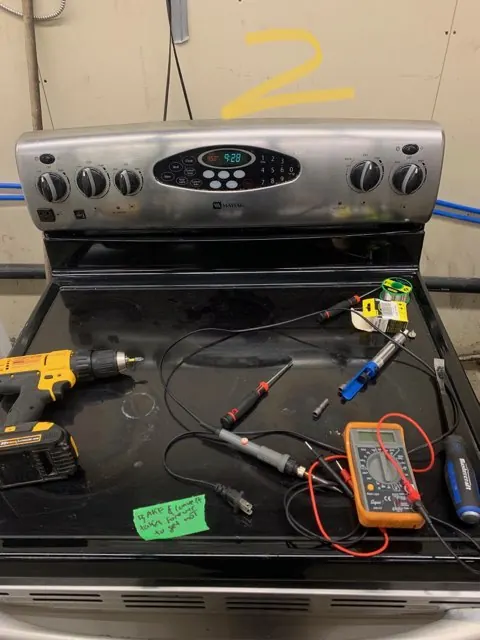
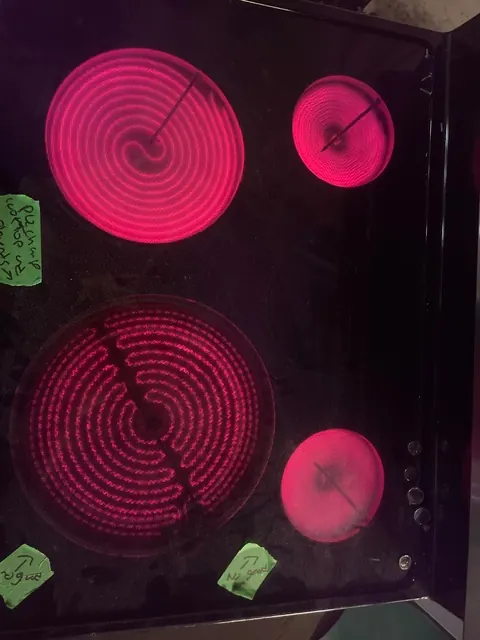
Real RepairWell photo · An electric range set up for testing.
The short version
Why it happens, what's normal, when it's a repair
1
Why it happens
After a cleaning, the usual causes are cleaner residue left on the oven liner, spills that weren't wiped out, and grease or soil left in the oven for a self-clean cycle to deal with. All of them burn the next time the oven heats.
2
What's normal
GE says a small amount of smoke during self-clean is normal, and steam or vapour from the oven vent is expected while food cooks. Whirlpool says a new oven can smoke or smell for its first few uses.
3
When it's a repair
Residue is a cleaning job. Smoke from a clean oven, sparks, or an element that glows in one bright spot points to a part, such as a failing element, wiring or a control letting the oven run hot. That needs a diagnosis in person.
The full guide
After a big holiday meal, plenty of ovens get a thorough clean. Then the next bake fills the kitchen with smoke. Most of the time that is residue burning off. Sometimes it isn't. Here is how to tell, and what to do in each case.
When some smoke is normal
Leftover cleaner. GE says not to use commercial oven cleaner in or around any part of a self-clean oven. If some was used, rinse every trace away with clear water on a damp, not soaked, cloth before the oven is heated or self-cleaned again. Residue left on the liner smokes the next time the oven heats.
Spills burning off. Juice, grease and sugar that land on the oven floor smoke each time the oven heats, until they are cleaned off.
During a self-clean cycle. GE says a small amount of smoke during self-clean is normal, and that a lot of smoke is caused by excessive grease or soil inside the oven. Its advice: turn the oven off, let it cool for at least an hour, wipe out the grease, then start the cycle again.
A new oven. Whirlpool says new parts, insulation and protective oil heating up for the first time can smoke or smell. It suggests removing all packaging and running Bake at 175 °C (350 °F) for 60 minutes, repeating once or twice if the smell persists, and opening a window or running the kitchen vent.
After a self-clean cycle
Let the oven cool completely; the door stays locked until it does. Wipe the leftover ash out with a damp cloth. Dark, oily patches that are still there mean the cycle didn't burn them off. Heavy soil is better wiped out before a self-clean than left for the cycle, which is exactly what GE's smoke advice comes down to. Open a window or run the range hood for the first few heat-ups afterwards.
Steam or smoke from the top or back of the range
Ovens have to vent hot air somewhere. GE says that on many freestanding ranges and wall ovens the oven vent is near the control panel, and on its freestanding radiant ranges it is a duct on the backsplash behind the right rear burner. GE also says it is normal to see steam or vapour coming from that vent while baking, roasting or broiling, and possible to see some smoke depending on what is in the oven. GE adds that the vent area should be cleaned regularly.
So a wisp from the vent while a roast is in is not a fault. What we pay attention to: whether it is steam or smoke, whether it smells of food and grease or of something hot and electrical, and whether there is a spill, a pan or anything plastic sitting on or near the vent.
When to stop
Flames inside the oven: turn the heat off and keep the door closed to contain the fire. Call 911 if the fire is growing.
Sparks, arcing, or a hot electrical or melting-plastic smell: turn the oven off and don't use it until it has been checked.
A rotten-egg smell on a gas oven: leave the house and call your gas utility from outside. See our page on a smell of gas.
Don't take panels off or test wiring yourself.
When it may be a part
If the oven has been cleaned properly and still smokes, the cause may be something that needs checking in person. Possibilities include a bake or broil element starting to fail (it can smoke, glow unevenly or spark before it stops), food baked onto a hidden element under the oven floor, or a temperature sensor or control letting the oven run hotter than set. An oven that also heats slowly is covered in our story about an oven slow to preheat.
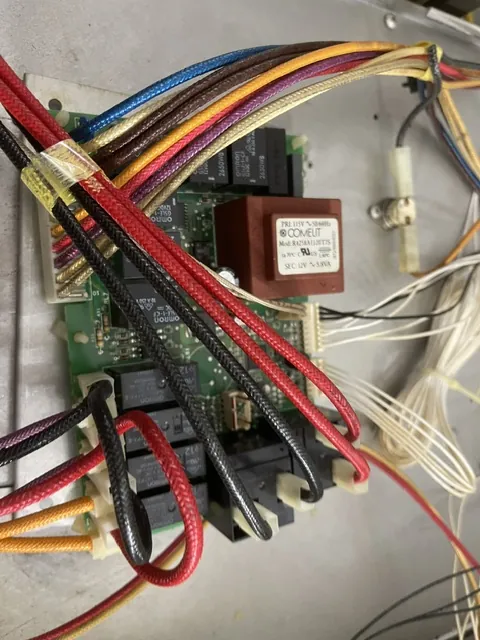
An oven's relay board and high-temperature wiring.
The photo above is from a different job: an oven relay board with its high-temperature wiring. Connections like these, and the terminals at each element, are part of what we check when an oven smokes or smells hot.
What we check
We confirm whether the smoke is residue or a part. We look at the elements and their connections, check that the oven reaches and holds the set temperature with a separate thermometer, and look at the vent path and the door gasket. On gas ovens, licensed gas technicians check the burner and ignition. You get the cause, the price and our repair-or-replace verdict in writing before any work starts.
The diagnostic is $89 + tax for an electric oven at home and $129 + tax for a gas oven, waived when you proceed with the repair. Call or text (613) 880-3013, or book online.
Before you book, a few safe checks
Let the oven cool, then wipe out ash, spills and any cleaner residue with a damp cloth and clear water.
Remove any foil or liner from the oven bottom once the oven is cold.
Make sure nothing is sitting on or near the oven vent on the cooktop or backsplash.
Open a window or run the range hood the first few times the oven heats after a clean.
Anything involving live wiring, gas or refrigerant is technician-only.
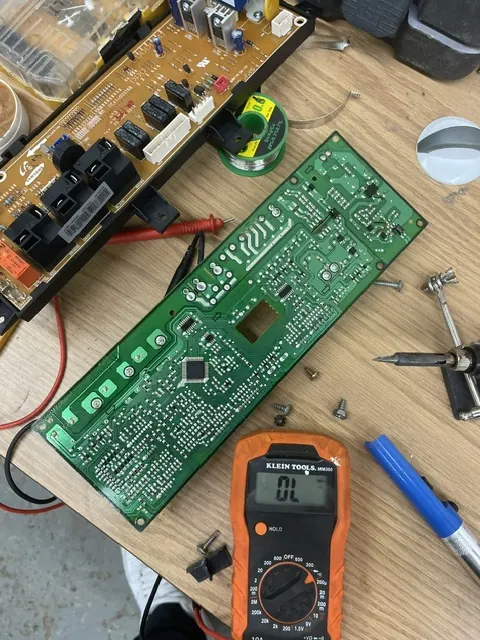
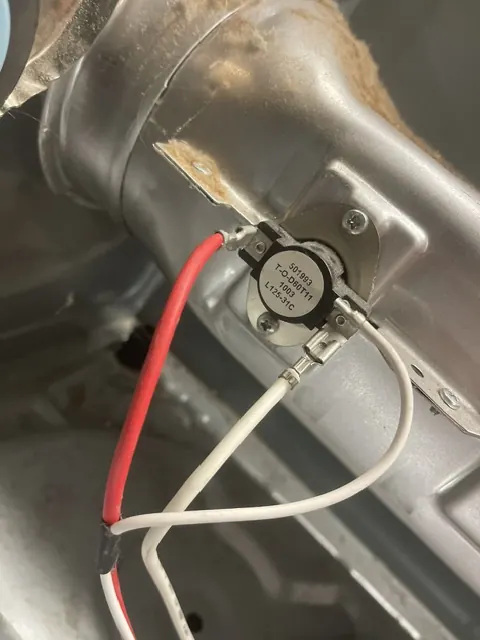
The photos in this guide are from real RepairWell repairs and show the kind of parts discussed; they are not from one specific job. Every appliance is different, so your oven may have a different cause; the diagnostic visit confirms it.
Pick a preferred day and arrival window online; we confirm by email once a technician is assigned.
$89 + tax diagnostic$129 + tax for gas or commercial appliances and for Thermador, Miele, Viking, Wolf or Fisher & Paykel; waived when you proceed with the repair
Written finding on every visitCause, price and our repair-or-replace verdict
90-day warrantyOn parts replaced; labour depends on the work done
May we use Google cookies to count visits, calls and booking requests, and to see which of our Google ads led to them? They stay off unless you accept. Privacy